Artificial intelligence is no longer just powering chatbots or automating tasks. Scientists are now using it to predict people’s future health risks years in advance—similar to how meteorologists forecast the weather.
Instead of telling you it will rain on Tuesday, this technology estimates the likelihood of developing diseases such as type 2 diabetes, heart conditions, or sepsis over the next decade.
How AI Forecasts Health Risks
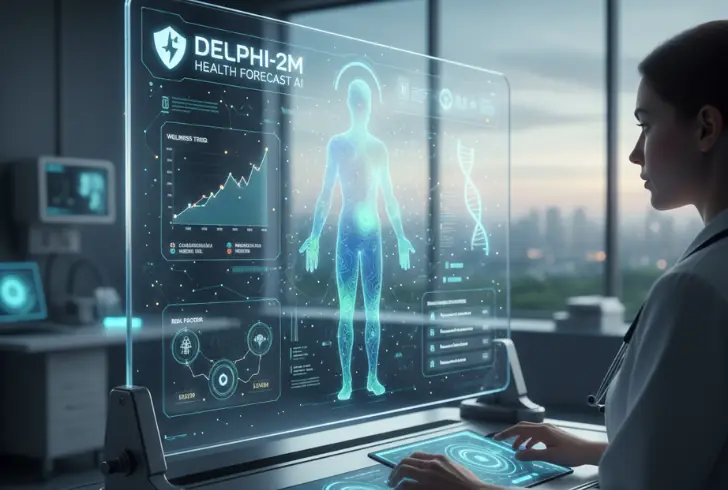
The system, known as Delphi-2M, works by detecting hidden patterns in medical records. Just as language models predict the next word in a sentence, Delphi-2M predicts what health condition might appear next in someone’s medical timeline. The model doesn’t provide exact dates. Instead, it calculates probabilities—for example, a 70% chance of developing a certain illness within a specific timeframe.
This kind of prediction opens new opportunities for healthcare providers. Instead of reacting to diseases after they appear, doctors could identify high-risk patients early and step in with preventive care.
Where the Data Comes From
The foundation of Delphi-2M is a large collection of anonymous medical information. It was initially trained using data from more than 400,000 people in the UK Biobank, which included hospital visits, primary care records, and lifestyle details like smoking habits. To test its reliability, researchers compared the model’s predictions against data from other Biobank participants and later on 1.9 million Danish medical records.
Results showed strong accuracy. When the model predicted a one-in-ten chance of a health issue, real-world outcomes closely matched those probabilities. This consistency demonstrates that AI can provide forecasts not only at an individual level but also across entire populations.
The Diseases AI Predicts Best
Delphi-2M has proven especially accurate in identifying conditions with a clear progression. These include type 2 diabetes, heart attacks, and sepsis—diseases that often show early warning signs in medical data. On the other hand, unpredictable health events such as infections remain harder to forecast.
By pinpointing risks with such precision, the system could help patients and physicians focus on prevention strategies. A person identified as high-risk for liver disease, for example, might benefit more from lifestyle changes like reducing alcohol consumption compared to the general population.
Broader Applications in Healthcare
Beyond individual health, this technology could reshape how hospitals plan resources. If AI can estimate how many cases of heart disease or other conditions a city may face in 2030, healthcare systems can better prepare staff, equipment, and treatment facilities. This predictive power makes it possible to anticipate demand years before it arrives.

AI-driven forecasts also hold promise for improving disease-screening programs. By identifying which groups are most likely to face certain illnesses, public health organizations can target preventive efforts more effectively.
Challenges and Next Steps
While the early results are promising, this tool is not yet ready for clinical use. The current model is primarily based on UK Biobank data, which encompasses individuals between the ages of 40 and 70. That creates potential biases, since younger and older populations are not equally represented. Researchers are now refining Delphi-2M by incorporating additional medical data, including imaging, genetics, and blood analysis.
Experts emphasize that thorough testing and regulation are crucial before introducing this technology into hospitals. Past innovations like genomics took nearly a decade to move from research confidence to routine clinical use, and AI forecasts are expected to follow a similar path.
A Step Toward Predictive Medicine
The ability of AI to calculate health risks years in advance marks a turning point in medical research. Instead of waiting for diseases to develop, predictive models like Delphi-2M show the potential to shift healthcare toward prevention and preparation.
By analyzing vast amounts of medical data, this technology offers insights into both individual well-being and public health planning. If refined and responsibly implemented, it could help doctors intervene earlier, improve patient outcomes, and support smarter resource management.
The promise of AI in medicine is no longer science fiction—it is steadily becoming a reality.