
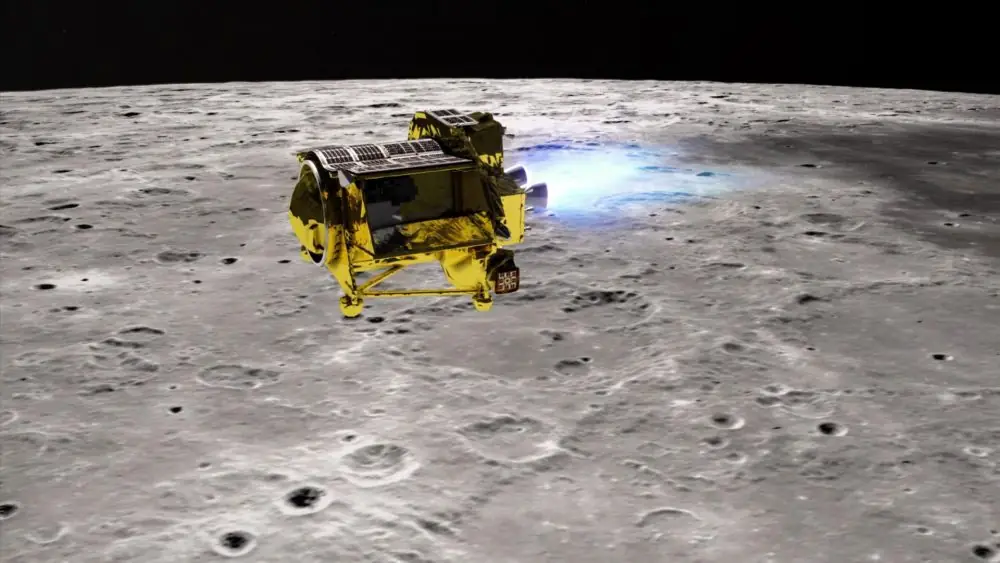
On January 20, 2024, Japan marked a significant milestone in space exploration by successfully landing its Smart Lander for Investigating the Moon (SLIM) on the lunar surface. This remarkable feat made Japan the fifth nation globally to achieve a lunar landing, a testament to its burgeoning prowess in space technology.
Despite a power issue with the lander, the mission symbolizes not just a political triumph but a leap in technological innovation.
The Conversation / Successfully landing its SLIM craft on the moon on January 20, Japan became the 5th country to land its craft on the moon.
While the craft’s landing was a success, it encountered a critical challenge: its solar cells were not functioning optimally. This malfunction meant that SLIM could operate for only a limited time, possibly just a few hours. However, this hiccup does not overshadow the broader significance and technical achievements of the mission.
SLIM’s most notable contribution to space exploration is its cutting-edge precision-landing technology. This technology enables spacecraft to land in relatively small, complex terrains, such as rocky or uneven areas. This capability is a game-changer, particularly as future missions target specific lunar regions, like the resource-rich South Pole.
The technology behind SLIM’s precision landing is remarkable. The spacecraft utilized a vision-based navigation system created using data from previous missions.
GTN / Japan’s latest innovative technology Smart Lander for Investigating the Moon (SLIM) made the lunar journey of the country possible.
This system allowed SLIM to pinpoint its landing within a 100-meter zone, a significant improvement over past landers. Something that required multiple kilometers of clearance.
SLIM’s mission also included deploying two unique rovers, each showcasing novel lunar mobility technologies. Lunar Excursion Vehicle 1, equipped with a camera and scientific instruments, utilizes a hopping mechanism for movement, an inventive approach to navigating the Moon’s terrain.
Meanwhile, Lunar Excursion Vehicle 2, a collaboration between government, industry, and academia, is a compact, palm-sized sphere. Once deployed, it separates into two halves, allowing it to roll over the lunar surface, a novel design in planetary exploration.
Japan’s advancements in precision landing are not just a technical feat. They hold significant implications for future lunar missions. As nations and agencies focus on specific lunar regions, particularly those believed to contain valuable resources like ice, the ability to land accurately and safely becomes paramount.
Elle / Japan’s SLIM mission demonstrates a critical capability in this regard, potentially shaping the future of lunar exploration and resource utilization.
Japan’s successful lunar landing places it at the forefront of space exploration, alongside other spacefaring nations. This achievement is a clear indicator of Japan’s ambitions and capabilities in space technology. Likewise, it also positions the country as a key player in future international space endeavors. Thus, potentially influencing collaborations and innovations in the years to come.
Japan’s SLIM mission, despite its power issues, represents a significant step forward in space exploration. Its precision-landing technology not only enhances the capability of lunar missions. But it also opens up new possibilities for exploring and utilizing the Moon’s resources.
As we look to the future, Japan’s achievement is not just a national triumph but a milestone for humanity’s quest to understand and explore our celestial neighbor. The journey to the Moon continues, and Japan has firmly established itself as a leader on this path.